Direct Vent Gas Fireplaces

A direct vent gas fireplace is the modern standard for new construction and major remodels, combining high efficiency, sealed combustion safety, and flexible installation through a wall or roof.

Direct vent units use a coaxial pipe (a pipe inside a pipe) where the inner pipe exhausts combustion gases outside and the outer pipe draws fresh combustion air in. The firebox itself is sealed behind tempered or ceramic glass, so the unit never pulls heated indoor air up the flue. The result is 70 to 85 percent efficiency, an order of magnitude better than a traditional open fireplace.

Every direct vent gas fireplace at Fireplace Insider ships free nationwide with white glove delivery and is backed by our price match guarantee. We carry traditional, contemporary linear, multi sided, see through, and peninsula configurations from Napoleon, Heat & Glo, Majestic, Superior, Montigo, Town & Country, and other premium hearth manufacturers. Use our BTU calculator to match output to your room size before selecting a model.

20 plus years in the hearth industry Factory authorized dealer NFI certified specialists Sealed combustion, code compliant nationwide

How to Choose the Right Direct Vent Gas Fireplace

Six decisions that determine whether your new fireplace performs and looks the way you imagined.

Pick the configuration first

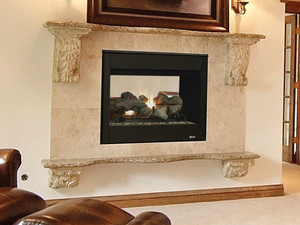
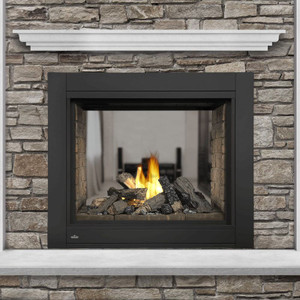
Single sided is the standard configuration, viewed from one room. See through opens to two rooms back to back, ideal for separating a kitchen from a living room. Multi sided models (peninsula, corner, three sided) provide a sculptural focal point and are common in modern open floor plans. Linear models extend the firebox horizontally for a contemporary look. Configuration is locked once framing starts, so decide first.

Plan the vent path before you select a model

Direct vent units can terminate through an exterior wall (horizontal termination) or through the roof (vertical termination). Each manufacturer publishes a maximum vent length and a required ratio of vertical to horizontal runs. A short straight shot through the wall is the simplest install. Long horizontal runs with multiple elbows require larger vent pipe and may cap the maximum BTU rating you can use. Confirm your vent path matches the model's vent table before ordering.

Size the BTU output to the room, not the fireplace opening

Direct vent fireplaces range from 15,000 to 60,000 BTU. As a rough guideline, plan on 20 to 30 BTUs per square foot of insulated space. A 25,000 BTU unit handles a typical 800 square foot family room. Oversizing a unit causes short cycling, glass overheating, and forces the operator to leave the door open to compensate. Use the BTU calculator with your real room dimensions.

Choose the finish and media set

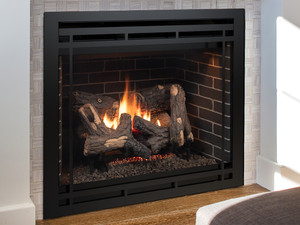
A direct vent fireplace has multiple finish decisions. The interior liner (brick, herringbone brick, stone, or reflective black ceramic) sets the visual tone. The media set (split logs, contemporary glass beads, river rock, driftwood) sets the style. The front face or surround (clean face for modern, louvered for traditional) is the most visible element. These options change the price by $300 to $1,500 and define how the fireplace looks for the next 20 years.

Plan for TV mounting if you want one above

Most direct vent fireplaces require a minimum clearance from the top of the unit to combustibles, including a wall mounted TV. Premium models from Heat & Glo (Cool Wall), Montigo (Power Vent), and Napoleon (Heat Management) include heat redirect systems that pipe excess heat away from the wall above, allowing closer TV mounting. If a TV above the fireplace is non negotiable, filter to models with heat management before going further. See our TV clearance guide.

Confirm the control system matches your lifestyle

Three control tiers exist. Standing pilot with a wall switch is the simplest and works during a power outage but burns gas continuously. Intermittent pilot ignition with battery backup lights only on demand and still works during an outage. Smart controls add WiFi, app control, programmable thermostats, and voice assistant compatibility. The added cost of intermittent ignition (typically $200 to $400) pays for itself in saved gas within 18 to 24 months.

Direct Vent Gas Fireplace Questions

The questions our hearth specialists answer most often before a customer places an order.

What is the difference between direct vent and vent free?

Direct vent uses a sealed combustion system that draws outside air for combustion and exhausts all combustion gases outside through a coaxial pipe. The firebox is sealed behind glass and never mixes combustion gases with indoor air. Vent free burns gas inside the home and releases the combustion byproducts (including water vapor and trace carbon monoxide) directly into the room. Vent free is more efficient on paper (nothing exhausts outside) but is restricted by code in several states. Direct vent is the modern standard and is code compliant everywhere.

How much does a direct vent gas fireplace cost installed?

Total installed cost typically lands between $4,500 and $12,000. The unit itself runs $1,500 to $6,000 for mainstream models and $6,000 to $15,000 for premium linear or multi sided configurations from Town & Country, Montigo, and Heat & Glo. Installation costs include framing, gas line, vent pipe and termination, surround or veneer work, and electrical for the blower. New construction installs run on the lower end; retrofitting into an existing wall is more expensive.

Do direct vent fireplaces need a chimney?

No. That is the main advantage of direct vent. The coaxial vent pipe can terminate through any exterior wall or through the roof, with no chimney required. This is what makes direct vent the default choice for new construction (no expensive masonry chimney needed) and for second story or basement installations where running a chimney is impractical.

Are direct vent gas fireplaces safe?

Yes, direct vent is widely considered the safest gas fireplace technology. The sealed firebox prevents combustion gases from entering the home, the glass front prevents accidental contact with flames, and modern units include automatic shutoff if the vent becomes blocked or the unit overheats. A CO detector in the same room is still recommended as a safety best practice but the risk of CO exposure from a properly installed direct vent unit is extremely low.

Can you put a TV above a direct vent gas fireplace?

Sometimes, depending on the model. Many direct vent fireplaces produce enough heat at the top to damage a wall mounted TV. Models with built in heat management systems (Heat & Glo Cool Wall, Montigo Power Vent, Napoleon Heat Management) redirect heat away from the wall above and allow safe TV mounting at standard heights. Without a heat management system, you need at least 8 to 12 inches of clearance above the unit, often more. Check the model spec sheet before committing to a TV placement.

FI

Curated by the Fireplace Insider hearth team

Fireplace Insider is operated by hearth specialists with more than two decades of fireplace installation experience and thousands of completed projects. Every direct vent unit in this category has been vetted by an NFI certified specialist for vent path flexibility, BTU rating, and heat management features.

Talk to a hearth specialist