
Installation Guides
A short answer up top, then the install details from someone who actually does this for a living, what works, what does not, and where homeowners go wrong.
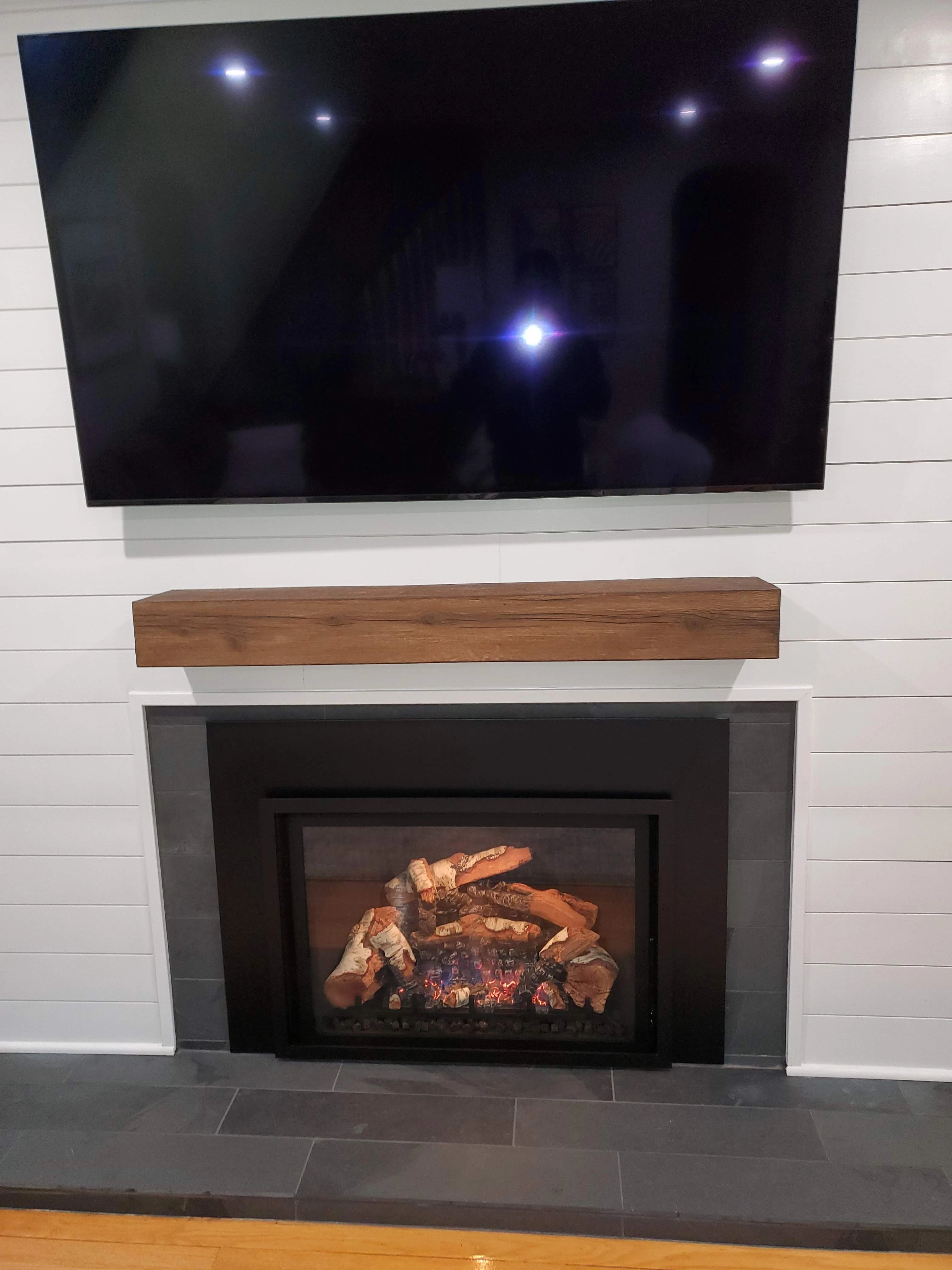
Short answer: There is no single number that works for every fireplace. The TV has to sit above any mantel, and the mantel has to respect the fireplace manufacturer's minimum clearance to combustibles; which varies by model. For most gas inserts and gas fireplaces, the TV ends up 50 to 60 inches above the floor when the install is planned correctly. For wood inserts and wood fireplaces it is higher. The most important rule is simple: always install a mantel between the fireplace and the TV, and read your specific unit's install manual before drilling anything.
I install around 20 of these setups every year ; gas inserts, wood inserts, gas fireplaces, and wood fireplaces, all with TVs mounted above. Over the past few years I have seen every variation of this question come through the showroom and through customer service: how high, what mantel, what depth, what about the heat. The mechanics are not complicated, but the planning is where most homeowners and even some builders get it wrong.
Below is the framework I use on every install. It applies whether you have already bought the fireplace or you are still picking one out. If you take one thing away from this article, take this: the mantel is the most important component in the entire stack. Skip the mantel and the rest of the math does not save you.
Step 1: Find Your Fireplace's Minimum Clearance to Combustibles
Every fireplace, insert, stove, and firebox sold in North America comes with an install manual that lists the minimum clearance to combustibles. This number is the distance from the top of the fireplace opening (or the top of the unit, depending on how the manufacturer measures it) to the bottom of any combustible material above. It is not a suggestion. It is the safety distance the manufacturer tested and certified the unit at, and it is what the building code refers to.
Find this number first. It will be in the install manual under a section usually titled "Clearances" or "Combustible Mantel Clearance." If you bought the fireplace from us, the manual is in the box and also on the product page. If you cannot find it, send me the model and I will pull the spec.
Typical numbers I see in the field: gas inserts and direct-vent gas fireplaces commonly require 12 to 24 inches above the unit to a combustible mantel. Wood inserts and wood-burning fireplaces are higher, often 36 to 48 inches or more. Linear gas fireplaces and high-output models can require even more. Do not guess from these ranges ; every model is different.
Step 2: Decide Combustible vs Non-Combustible Mantel
This is the single biggest decision and where most of the planning happens.
A combustible mantel is wood, MDF, or any material that can ignite. It must be installed at or beyond the manufacturer's minimum clearance to combustibles. If your fireplace says 18 inches, the bottom of a wood mantel must be at least 18 inches above the top of the unit. No exceptions, no rounding down, no "it'll be fine."
A non-combustible mantel is stone, tile, steel, concrete, or another material that cannot ignite. These do not have a clearance requirement. You can place them as close to the fireplace as you want, and the only thing driving placement is how it looks aesthetically.
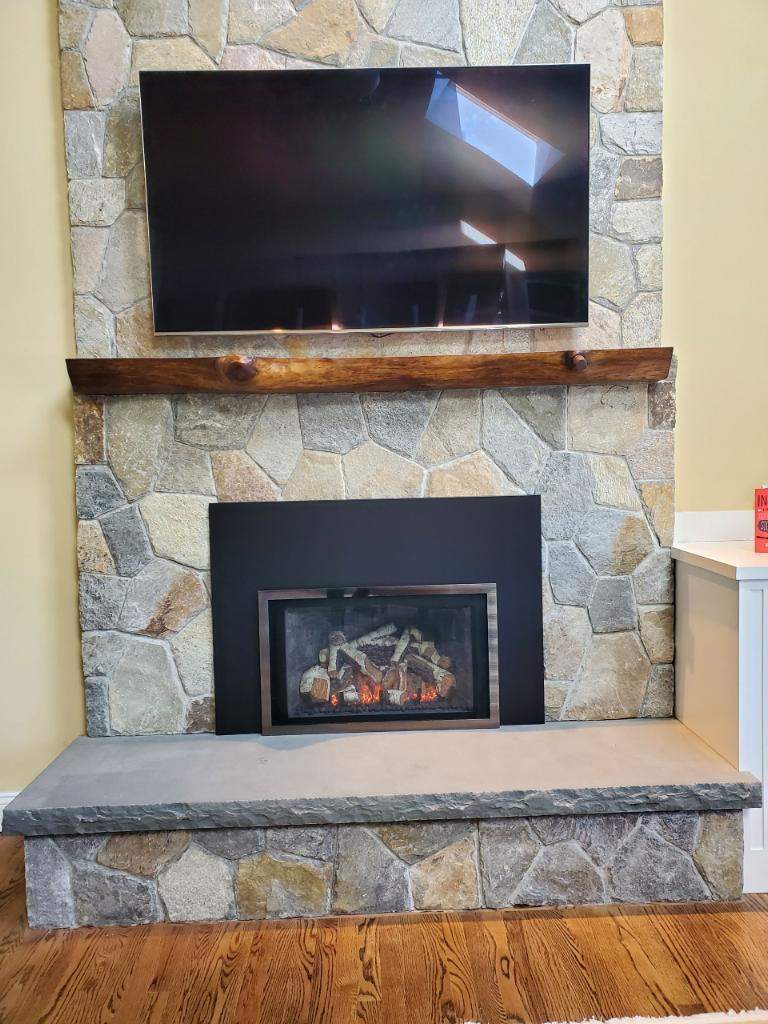
The installs that look best almost always use a substantial mantel ; wood or stone, doesn't matter ; that projects out from the wall by 6 to 12 inches. The depth matters because the mantel's job is to deflect rising heat outward and away from the TV above. A flush mantel that does not project from the wall is decorative, not functional. A projecting mantel acts like an awning and pushes heat into the room instead of letting it ride straight up the wall to your TV.
Step 3: Mount the TV Above the Mantel
The TV's bottom edge should sit just above the mantel. There is no clearance requirement between the mantel and the TV the way there is between the fireplace and the mantel; the mantel is doing the deflection work. But you still want the TV high enough that the mantel has room to do its job.
For ergonomics, the center of the TV should land roughly at seated eye level, which for most living rooms is 42 to 48 inches above the floor. If you can get there with the fireplace, mantel, and TV stacked correctly, you have a comfortable viewing setup. If the math forces the TV higher than 60 inches at center, you are in neck-strain territory and should reconsider the layout.
The Most Common Mistake I See
Customers skipping the mantel.
Almost every fireplace insert needs a mantel between the fireplace and the TV. I would say 100% of inserts in our showroom require one in real-world installs. The mantel is not a decorative add-on. It is the only thing keeping rising heat from drafting straight up the wall and into the underside of the TV, where the most heat-sensitive components live: HDMI ports, capacitors, and on newer OLED panels, the actual display drivers.
I have had customers tell me they want the "clean" look with the TV directly above the fireplace and no mantel. Some fireplaces can do this; specifically new construction units with engineered heat shifts that redirect heat sideways or upward through a separate vent, or models with plenums that release heat through the framing at the ceiling or sides. These are real options but they are almost always new construction or full renovations. You cannot retrofit a heat shift into an insert. If you are putting an insert into an existing masonry fireplace, you need a mantel. End of story.
The Second Most Common Mistake (And This One Is on Builders)
In new construction and major renovations, I regularly walk into a finished framed-out wall where the homeowner or builder has raised the firebox too high. Their thinking: "Let's put the fireplace up at chest level so it's a feature." Then they realize the mantel has to sit above the unit by the manufacturer's clearance, and the TV has to sit above that. The result is a TV at 70 or 75 inches above the floor.
That looks horrible. It is uncomfortable to watch. And by the time it gets to me, the framing is done and the only fix is to redo the wall.
If you are doing new construction or a renovation, plan the entire stack on paper before anyone frames anything. Start from the TV's ideal viewing height (around 42 to 48 inches at center), work backward through the mantel and the fireplace clearance, and that tells you how high the firebox should sit. If you do it the other way around ; firebox first, TV last ; you will end up looking at the ceiling.
When I Say No
I have told customers they cannot or should not install a TV above a fireplace. The most recent time was a customer whose existing mantel was already mounted very high from a previous install, and the only place the TV could go was somewhere absolutely ridiculous ; close to the ceiling, terrible viewing angle. The geometry just did not work.
I told them honestly: do not put a TV here. The post-install regret is worse than the disappointment of changing the plan. We worked out a different layout where the TV went on an adjacent wall and the fireplace stayed the focal point on its own. They were happier with the result and they thanked me later.
The point: a good installer will tell you when something is a bad idea. If somebody is willing to install a TV above a fireplace without asking about the clearance, the mantel, or the room geometry, find a different installer.
Quick Checklist Before You Mount Anything
- Pull the fireplace's install manual and find the minimum clearance to combustibles.
- Decide on a combustible or non-combustible mantel. Combustible follows the manual; non-combustible does not.
- Make sure the mantel projects from the wall by at least 6 inches so it actually deflects heat.
- Plan the TV's bottom edge just above the mantel and confirm the TV center is between 42 and 60 inches off the floor.
- For new construction, design the stack from the top down (TV → mantel → fireplace), not the other way.
- If you are putting in an insert, plan on a mantel. Always.
- If anything in the geometry forces the TV above 60 inches at center, reconsider the layout entirely.
Have a Specific Unit? Ask Me Directly
Every fireplace has its own clearances, and every room has its own constraints. If you want a real answer for your specific model and your specific space, send me the details using the form below. Tell me:
- The fireplace make and model (or what you are considering)
- Whether it is going into an existing masonry fireplace or new construction
- Your ceiling height and any constraints on the wall
- The TV size you want to mount
I will tell you whether a TV install works, what mantel you need, and what the final viewing height will be. No charge, no obligation, just a real answer from someone who installs these for a living.
Considering an insert?
Use our free sizing calculator to confirm the insert fits your existing fireplace before you buy.
Check My Insert Will FitFrequently Asked Questions
How close can I mount my TV above a fireplace?
There is no single number that works for every fireplace. Each manufacturer publishes a minimum clearance to combustibles in the install manual, and the TV must sit above any combustible mantel that respects that clearance. For most gas inserts and gas fireplaces, the TV typically ends up 50 to 60 inches above the floor when planned correctly. For wood inserts and wood fireplaces, it is usually higher. Always check your specific model's manual or ask us before mounting.
Do I need a mantel between the fireplace and the TV?
In almost every case, yes. A mantel deflects rising heat away from the TV and is the single biggest factor in a safe install. Combustible mantels (wood, MDF) must follow the manufacturer's minimum clearance to combustibles. Non-combustible mantels (stone, steel, tile) do not have a clearance requirement and can be placed for purely aesthetic reasons. A handful of fireplaces with heat shifts or plenums can run without a mantel, but those are almost always new construction units.
Can I mount a TV above a wood-burning fireplace?
Yes, but the heat output and clearance requirements for wood-burning fireplaces and wood inserts are significantly higher than gas. The mantel and TV will sit higher, and the room layout has to accommodate that. If your ceiling is only 8 feet, the TV may end up uncomfortably high to look at. Plan the install before committing to the unit.
What is the most common mistake people make?
Skipping the mantel. The mantel is what protects the TV from rising heat. Without one, hot air drafts straight up the wall and into the underside of the TV, where heat-sensitive components like HDMI ports and capacitors live. The second most common mistake is in new construction: builders raise the firebox so high that even with the correct clearance, the TV ends up at an awkward viewing height.
Will mounting a TV above my fireplace damage the TV?
It can, if the install ignores the manufacturer's clearance and skips a deflecting mantel. TVs are not rated for sustained ambient temperatures above about 100 degrees Fahrenheit, and the area directly above an operating fireplace can easily exceed that without proper deflection. Done correctly, with a mantel and proper clearance, mounting a TV above a fireplace is safe and is one of the most popular installs we do.
Ask a Specialist
Have a Question About Your Specific Fireplace?
Send me the details and I will tell you whether a TV install works for your unit, what mantel you need, and what the final viewing height will be. No charge, no obligation.