Vent Free Gas Fireplaces

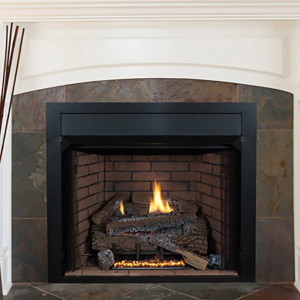
A vent free gas fireplace delivers up to 99.9 percent heating efficiency with no flue, no chimney, and no exterior wall penetration, making it the most versatile option for rooms where venting is impossible or impractical.

Vent free fireplaces burn natural gas or propane at near complete combustion, releasing virtually all heat directly into the room. Outputs typically range from 10,000 to 40,000 BTUs, enough to heat 300 to 1,200 square feet. Every model Fireplace Insider sells includes an Oxygen Depletion Sensor (ODS), ships free nationwide with white glove delivery, and is backed by our 20 plus years of hearth industry experience and price match guarantee.

We carry vent free units from Superior, Empire, White Mountain Hearth, Astria, and Majestic, in firebox, linear, and traditional log set styles. For models that require venting, see our Direct Vent Gas Fireplaces collection or use our BTU Calculator to confirm sizing.

99.9% Efficient ODS Safety Equipped Free White Glove Shipping Price Match Guarantee

How to Choose the Right Vent Free Gas Fireplace

Six factors that determine whether a vent free unit is right for your room and code jurisdiction.

Confirm vent free is legal in your state

Vent free appliances are permitted in most of the United States, but several states and municipalities restrict or prohibit them, including California and parts of New York City, Massachusetts, and Alaska. Check your local building department before purchase. Fireplace Insider can confirm code status for your zip code if you are unsure.

Size BTU output to room volume, not square footage

Because vent free units release all combustion byproducts into the room, sizing is conservative. Plan on 20 BTUs per square foot in a well insulated space, and never install a unit that exceeds the room volume rating in the manual. A 30,000 BTU unit requires roughly 3,000 cubic feet of room volume. Our BTU Calculator includes vent free sizing.

Verify the room has adequate fresh air

Newer homes built to tight energy codes can be too sealed for vent free operation. The unit needs roughly 50 cubic feet of room volume per 1,000 BTUs of input. In smaller or tightly insulated rooms, a fresh air intake may be required. If the room has frequent door openings to the rest of the home, the requirement is easier to meet.

Choose between a firebox or a log set

Vent free fireboxes are complete units with a sealed cabinet, controls, and burner ready to install. Vent free log sets drop into an existing fireplace cavity and convert it into a vent free heater. Fireboxes are better for new construction or finished walls. Log sets are the fast retrofit when a masonry firebox is already in place.

Plan for the ODS and bedroom restrictions

Every vent free appliance sold today includes an Oxygen Depletion Sensor that shuts the unit off if room oxygen falls below 18 percent. The ODS is required by national standards. Most codes also limit vent free units in bedrooms to 6,000 BTUs and prohibit them entirely in bathrooms under 90 square feet. Check the install manual.

Budget for fuel type and supply

Vent free units run on natural gas or propane. Natural gas is cleaner burning and more economical where available. Propane operation requires the correct conversion kit installed from the factory, never substituted later. Gas line sizing matters at higher BTU levels. A 40,000 BTU unit may require a half inch supply line at the appliance for proper pressure.

Vent Free Gas Fireplace Questions

The questions our hearth specialists answer most often before a customer places an order.

Are vent free gas fireplaces safe?

Yes, when installed and sized correctly. Every vent free appliance includes an Oxygen Depletion Sensor that shuts the unit off before oxygen falls to unsafe levels. The technology has been certified to ANSI Z21.11.2 standards for decades. Following the room volume sizing rules and keeping the burner clean are the key requirements.

Why are vent free fireplaces banned in some states?

California prohibits vent free appliances under state air quality rules. New York City and parts of Massachusetts restrict them under local building codes. The concerns relate to indoor air quality in tightly sealed homes. Where vent free is allowed, modern ODS equipped units meet all federal safety standards.

How much moisture does a vent free fireplace add to the room?

A vent free unit produces roughly one gallon of water vapor for every 100,000 BTUs of input over a full burn. In a typical 25,000 BTU unit running four hours, that is about one cup of moisture released into the room. Cracking a window or running a bath fan briefly is enough to manage humidity.

Can a vent free fireplace heat my whole house?

No. Vent free units are designed as zone heaters for the single room where they are installed. A 30,000 BTU unit will heat that room and contribute to adjacent open areas. Whole house heating requires a furnace, boiler, or heat pump. Vent free works well as a supplement during power outages or shoulder seasons.

Do vent free fireplaces smell when they run?

A new unit may give off a slight odor for the first several hours of use as manufacturing residues burn off. After break in, a properly adjusted vent free unit should produce no noticeable smell. Persistent odors usually indicate the burner needs cleaning or the gas to air ratio needs adjustment by a qualified service technician.

FI

Curated by the Fireplace Insider hearth team

Fireplace Insider is operated by hearth specialists with more than two decades of fireplace installation experience and thousands of completed projects. Every vent free gas fireplace in this category has been vetted by an NFI certified specialist for ODS compliance, BTU sizing, and room volume requirements.

Talk to a hearth specialist