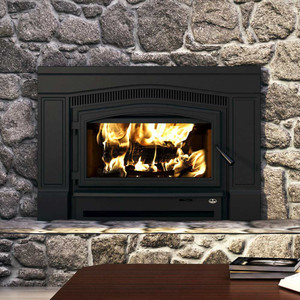
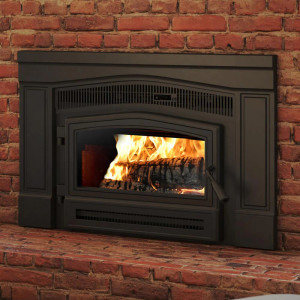
Wood Burning Fireplace Inserts

A wood burning fireplace insert turns an inefficient open fireplace into a high efficiency wood heater, capable of warming an entire floor of your home from a single load of firewood.

Wood inserts are EPA certified appliances engineered to fit inside an existing masonry or factory built fireplace opening. Where an open wood fire operates at 10 to 15 percent efficiency (and often pulls warm air out of the home through the chimney), a modern wood insert delivers 70 to 80 percent efficiency with one third the firewood and a fraction of the particulate emissions. Every wood burning insert at Fireplace Insider ships free nationwide with white glove delivery and is backed by our price match guarantee.

We carry catalytic, non catalytic, and hybrid combustion wood inserts from Osburn, Pacific Energy, Quadra-Fire, Regency, Valcourt, Napoleon, and other EPA certified premium manufacturers. If you are unsure which model fits your firebox, our free insert sizing calculator will narrow your options in under two minutes.

20 plus years in the hearth industry Factory authorized dealer NFI certified specialists EPA certified clean burn technology

How to Choose the Right Wood Burning Fireplace Insert

Six factors that determine how often you load wood, how cleanly the unit burns, and how warm your home actually gets.

Measure the firebox opening exactly

Wood inserts are sized to fit inside an existing masonry or zero clearance firebox. You will need the front width, rear width, depth, and height of the opening, plus the hearth depth in front of the unit. Wood inserts are deeper than gas inserts because they accommodate a full size firebox and ash pan. Many homes require the hearth to be extended forward to maintain the required 16 to 18 inch ember protection zone in front of the unit.

Choose your combustion technology

Three combustion types dominate modern wood inserts. Non catalytic uses internal baffles and secondary air injection to re burn smoke at high temperatures, simplest design with minimal maintenance. Catalytic uses a honeycomb combustor (similar to a car catalytic converter) to ignite smoke at lower temperatures, delivering longer burn times but requiring combustor replacement every 5 to 10 years. Hybrid combines both, used in flagship models like the Blaze King and Pacific Energy Super 27 for the longest burn times available.

Match heating capacity to your home, not the room

Unlike gas inserts, wood inserts are typically sized to heat 1,000 to 3,000 square feet as a primary or zone heater. Smaller units (1.5 to 2.0 cubic foot firebox) heat 500 to 1,500 square feet. Larger units (2.5 to 3.0 plus cubic foot firebox) heat 1,800 to 3,000 plus square feet. Wood heat moves on convection and radiant transfer, so single floor heating reaches farther than central heated air. A correctly sized wood insert can heat a whole floor in moderate climates.

Verify the chimney liner requirement

Every modern wood insert requires a full length stainless steel chimney liner connecting the unit to the top of the chimney. This is required by code, by the EPA certification, and by the manufacturer warranty. A 6 inch insulated liner is standard. Liner kits add $400 to $1,200 to the install. Skipping the liner is the most common reason wood inserts under perform and create draft problems, in addition to being a code violation that voids insurance coverage in many states.

Plan for burn time and reload frequency

Burn time is the single most quoted spec for wood inserts and varies dramatically. Non catalytic models typically deliver 6 to 8 hours on a full load. Catalytic models reach 10 to 14 hours. Hybrid flagship models like the Blaze King Ashford or Pacific Energy Vista hit 20 to 30 hours on the longest setting, allowing one daytime and one overnight load to heat through 24 hours. Longer burn times require less wood handling but cost more upfront.

Choose the door, finish, and blower options

Wood insert aesthetics are driven by three choices. Door style ranges from traditional cast iron to large arched glass viewing windows. Surround panels in black, brushed nickel, or copper hide the gap between the insert and the fireplace opening. Blowers (almost always optional, sometimes included) push convected heat into the room rather than letting it stratify near the ceiling. A blower significantly improves perceived heat output and is worth the upgrade in any home with 9 foot or higher ceilings.

Wood Burning Fireplace Insert Questions

The questions our hearth specialists answer most often before a customer places an order.

Is a wood burning fireplace insert worth it?

For homeowners with access to firewood and an existing fireplace that is rarely used, yes. A wood insert delivers 70 to 80 percent efficiency compared to 10 to 15 percent for an open fireplace, using one third the firewood for the same heat output. Most owners with a free or low cost firewood supply recover the investment within 3 to 5 heating seasons through reduced primary heating costs. Insurance and resale value also benefit from converting an unused open fireplace to a certified appliance.

How much does a wood burning fireplace insert cost installed?

Total installed cost typically lands between $4,500 and $9,000. The insert itself runs $2,000 to $5,000 for mainstream EPA certified models and $4,500 to $7,000 for premium catalytic and hybrid units. Installation adds $1,500 to $3,500 and includes the stainless steel chimney liner, professional installation, surround panels, hearth extension if required, and inspection. Total cost is higher than a gas insert because of the required full length liner.

Can a wood insert heat the whole house?

A properly sized large wood insert can heat up to 3,000 square feet as a zone or primary heater in a single floor or open plan home. Multi story homes with closed floor plans typically use a wood insert as zone heat for the floor where it is installed, with central heat handling the rest. Heat from wood moves on convection and radiation, so it does not travel through ducts. Open stairways and floor plans extend the reach significantly.

Do wood burning inserts require a chimney liner?

Yes, every EPA certified wood insert sold today requires a full length stainless steel chimney liner from the unit to the top of the chimney. This is mandated by code, by the EPA certification, and by the manufacturer warranty. Liners cost $400 to $1,200 and are typically installed at the same time as the insert. Skipping the liner causes poor draft, creosote buildup, voided warranty, and is a code violation that affects insurance coverage.

How often do you load wood in a wood burning insert?

Reload frequency depends on the combustion technology and the burn setting. Non catalytic units typically need a reload every 6 to 8 hours on a low burn. Catalytic models reach 10 to 14 hours. Hybrid catalytic units from Blaze King and Pacific Energy hit 20 to 30 hours on the longest setting, allowing one morning load and one evening load to heat through a full day. Higher burn settings (more heat output) shorten reload intervals across all technologies.

FI

Curated by the Fireplace Insider hearth team

Fireplace Insider is operated by hearth specialists with more than two decades of fireplace installation experience and thousands of completed projects. Every wood insert in this category has been vetted by an NFI certified specialist for EPA certification, real world burn time, and proper liner sizing.

Talk to a hearth specialist