
Gas Fireplace Insert Buying Guide (2026): Sizing, Cost, and Top Brands
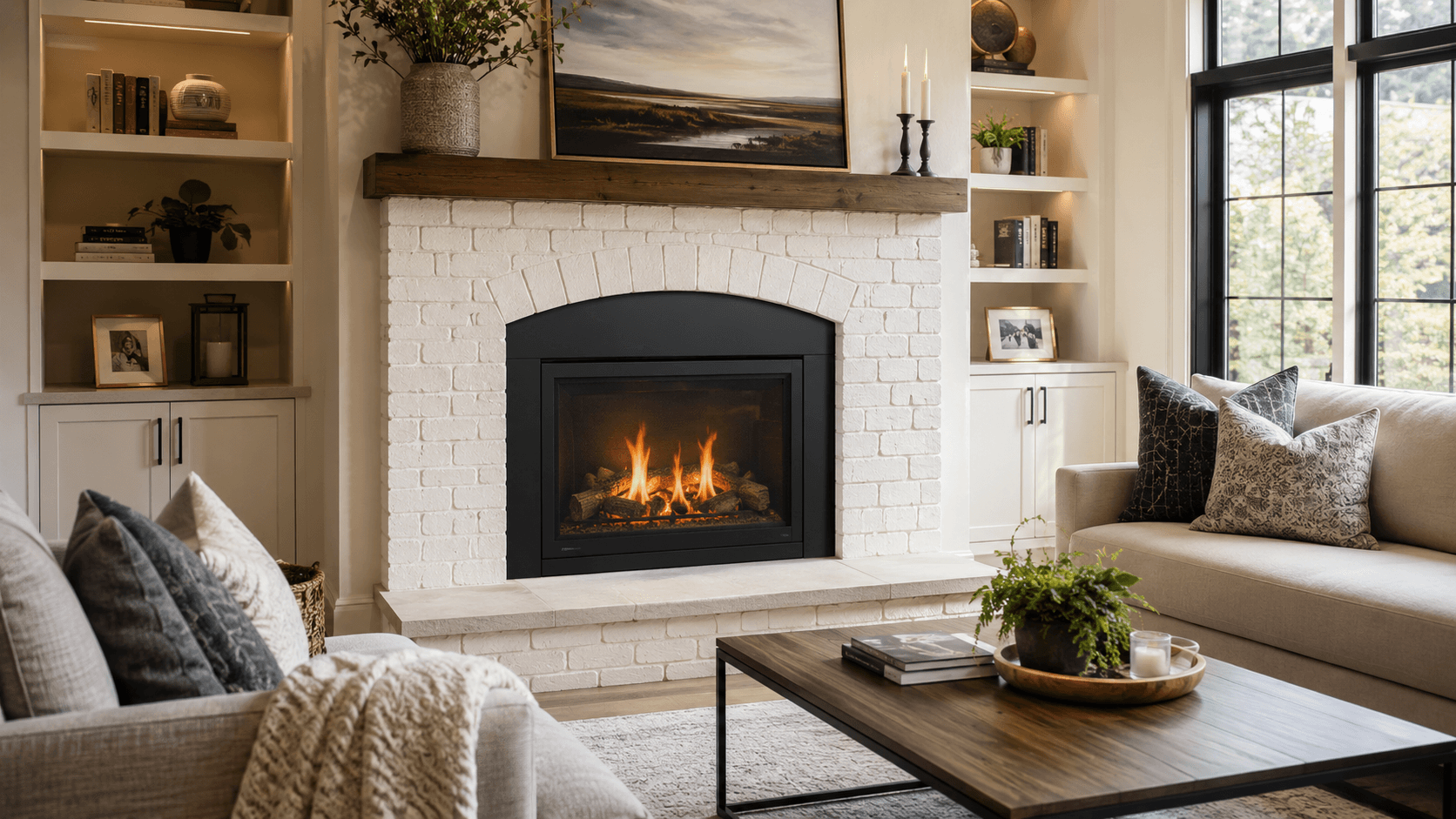
A gas fireplace insert turns an old, drafty wood-burning fireplace into a clean, efficient heater that runs with the push of a button. Many homeowners compare gas inserts with gas log sets at first, but they do not always realize how different the two products are. A gas insert is a sealed heating appliance with a blower, a dedicated exhaust vent, and a glass front that helps keep combustion gases out of the room.
Gas fireplace inserts are more expensive than gas log sets, but they are also safer, more efficient, and much better at heating the space. The blower helps move warm air into the room instead of letting most of the heat escape up the chimney. Done right, a gas insert can become the fireplace your family actually uses every day — not just something that looks nice.
What a Gas Fireplace Insert Actually Is
A gas fireplace insert is a sealed, self-contained firebox designed to slide into an existing masonry or factory-built wood-burning fireplace. It has its own burner, log set, glass front, blower, and vent system. Once installed, the original fireplace becomes the chase — the brick or stone you see is cosmetic, and the insert does all the real work.
This is fundamentally different from a built-in gas fireplace, which is a new appliance framed into a wall, and from a gas log set, which is a decorative burner that sits inside an open wood fireplace. An insert is the upgrade path for a home that already has a fireplace and chimney.
One of the biggest things customers miss is the safety and comfort difference. With a gas log set, the fireplace is still open to the room. With a gas insert, the flame is sealed behind glass and the unit vents combustion byproducts outside. When installed correctly, the exhaust is vented out through the chimney system instead of into the living space.
Quick check: If you have a masonry fireplace with a working chimney, a gas insert is almost always your best heating option. If you don't have an existing fireplace, look at direct vent gas fireplaces instead — those are designed to be built into a new wall.
Measuring Your Firebox Before You Shop
This is where many insert projects go sideways. The unit has to fit the existing fireplace opening with enough room for the body of the insert, vent connection, and finishing surround. At Fireplace Insider, the main measurements we ask for are simple: front width, back width, front height, and depth. With those measurements, we can usually narrow down which inserts will fit correctly.
The four measurements we need
- Front opening width: Left to right at the front of the firebox
- Back width: Left to right at the back of the firebox, because many fireplaces taper inward
- Front opening height: Floor of the firebox to the top of the opening
- Depth: Front to back, measured at the floor
Back width is the measurement many homeowners miss. Most masonry fireboxes are tapered — they're narrower at the back than the front. If the rear width is smaller than the insert body, the unit won't slide all the way in, no matter how much front clearance you have.
Write all four numbers down before you start comparing models. Every manufacturer publishes firebox-fit requirements in the spec sheet for each model, and those dimensions should always be confirmed before ordering.
Real customer lesson: One customer tried to save money by buying a gas log set instead of a gas insert. Later, he told us the fireplace area got warm, but it did not heat much beyond that. His wife also disliked the odor coming from the fireplace. They eventually removed the log set, came back for a gas insert, and later sent us a photo of the whole family around the fireplace at Christmas. That is the difference between a decorative gas log set and a true heating appliance.
Sizing: Matching BTU to Your Room
BTU, or British Thermal Units, is the heat output rating. Get this wrong and you'll either freeze or roast.
A rough rule of thumb for well-insulated modern homes in a moderate climate is about 20 BTUs per square foot of room being heated. Older or drafty homes, cathedral ceilings, or colder climates push that number up. Use the table below as a starting point, then adjust based on your room, insulation, layout, and climate.
| Room Size | BTU Range (Moderate Climate) | BTU Range (Cold Climate or Drafty) |
|---|---|---|
| 200–400 sq ft | 10,000–18,000 | 14,000–22,000 |
| 400–700 sq ft | 18,000–26,000 | 22,000–32,000 |
| 700–1,000 sq ft | 26,000–34,000 | 32,000–40,000 |
| 1,000+ sq ft (open plan) | 34,000–42,000+ | 40,000+ |
Most residential gas inserts on the market run between 20,000 and 40,000 BTUs. Skewing slightly under your max calculation is safer than oversizing if the only thing you are looking at is heat output — but BTU is not the only factor that matters.
Some customers worry that choosing a larger insert means the room will get too hot. In many cases, the larger model is actually the better-looking choice because it gives you more glass and a smaller faceplate around the opening. Most modern gas inserts allow you to adjust the flame height, lower the BTU output, use a thermostat, and turn the blower off when you only want radiant heat from the glass.
That is why sizing is not only about heat. It is also about how the finished fireplace will look. A smaller insert may technically fit, but it can require a larger surround to cover the gaps around the fireplace opening. Bigger unit, bigger glass, smaller faceplate — and often a cleaner finished look.
Real customer lesson: We have seen customers get nervous about buying a larger gas insert because they were afraid it would overheat the room. Later, they realized the larger insert would have created a better finished look because the glass would be bigger and the faceplate would be smaller. Heat can usually be controlled with flame adjustment, thermostat settings, and blower control. The finished appearance is much harder to fix after the wrong size is ordered.
Venting: What Your Existing Chimney Needs
A gas insert needs a sealed vent system that runs from the back of the unit up through your existing chimney to a termination cap. You can't just vent it into the open flue the way a wood fire does — gas inserts pull combustion air from outside and exhaust outside, all through a coaxial or co-linear liner.
Two paths exist depending on the model:
- Coaxial, or pipe-in-pipe: A single coaxial flex liner runs up the chimney. Combustion air comes down the outer channel, and exhaust goes up the inner channel. This can be simpler for shorter chimneys when the appliance is designed for it.
- Co-linear, or two separate pipes: A separate intake and exhaust run side by side. This is common for many gas insert installations and must match the manufacturer's installation requirements.
The chimney should be inspected before installation. The installer is looking for problems such as cracked tiles, deteriorated mortar, blockage, and clearance concerns. If the chimney is suitable, the liner runs up through the existing chimney and terminates with a proper cap. If there are chimney problems, those should be addressed before the insert is installed.
Bottom line: Budget for a proper stainless vent liner with every insert install. It is not an optional accessory — it is part of how the appliance is designed, tested, and approved to operate. Always follow the specific installation manual for the model being installed.
Natural Gas vs. Propane
Most gas inserts are available for natural gas or propane. Some ship configured for one fuel and require a manufacturer-approved conversion kit for the other. The kit changes the burner orifices and adjusts the regulator. Either fuel can work — what changes is operating cost, local availability, and sometimes BTU output.
Natural gas is usually cheaper per BTU in many U.S. markets and runs off your home's existing gas service. Propane is the answer when you don't have natural gas at the property — you'll need a tank and a properly sized line run to the insert. Propane delivers more heat per cubic foot, but it often costs more to operate depending on your local propane prices.
Confirm fuel type with the dealer before ordering. A natural gas insert running on propane without the correct conversion kit is dangerous and will void the warranty.
Real Installed Cost in 2026
Pricing varies by brand, BTU, and finish package, but here's what a realistic total looks like for a typical retrofit:
| Line Item | Typical Range |
|---|---|
| Gas insert (unit only) | $2,200 – $5,500 |
| Stainless flex liner kit | $400 – $900 |
| Surround / faceplate | $200 – $700 |
| Gas line work (if needed) | $300 – $1,200 |
| Professional installation labor | $800 – $1,800 |
| Chimney inspection | $150 – $400 |
| Total installed (typical) | $4,050 – $10,500 |
Entry-level and mid-range inserts usually fall near the lower or middle part of the range. Larger units, premium faces, larger surrounds, longer venting runs, gas line work, electrical work, or chimney issues can push the total higher.
Fireplace Insider sells and ships the product, but the customer needs a qualified local installer, plumber, electrician, or chimney professional for the work required at the home. That is the safest way to handle a gas appliance and make sure the installation follows the manufacturer's manual and local code requirements.
Need help sizing the right insert for your room?
Talk to a hearth specialist. No pressure, no upsell — just straight answers.
Request a Free Quote Call (203) 672-2567Brands Worth Shortlisting
The gas insert market has many options, but at Fireplace Insider, the two brands we trust most for gas fireplace inserts are Majestic and Superior. Both offer strong value, reliable performance, good parts availability, and product lines that work well for many standard masonry fireplace openings.
Majestic
Majestic is one of the brands we recommend most often for traditional gas insert projects. The company is part of Hearth & Home Technologies, one of the largest hearth manufacturers in the industry. That matters because parts, documentation, dealer support, and service resources are easier to access over time. For many homeowners, Majestic gives the right balance of price, reliability, and long-term support.
Superior
Superior is another brand we trust for gas inserts, especially when the customer wants a practical, well-priced heating appliance with good performance. Superior inserts work well for many standard fireplace openings and are a strong option for customers who want a dependable unit without moving into the highest price range.
Fireplace Insider recommendation: The best brand is not always the most expensive one. The right insert is the one that fits the fireplace correctly, gives the right finished look, provides the right amount of heat, and has long-term support after the sale.
What the Installation Actually Involves
A typical gas insert install takes one full day with a qualified installer, assuming the fireplace, chimney, gas line, and electrical requirements are straightforward. Here's the general sequence:
- Chimney inspection, often done as a separate visit before the install
- Confirm the insert, liner, faceplate, fuel type, and installation manual requirements
- Disconnect and remove old wood-burning components as needed
- Run the stainless vent liner from the firebox up through the chimney to a proper termination cap
- Slide the insert into the firebox and connect the venting to the insert collar
- Connect gas supply using the proper materials and a qualified professional
- Connect electrical for blower and ignition if the model requires it
- Install log set, media, embers, and glass front according to the manual
- Install surround or faceplate
- Pressure test gas connections, leak check, light the appliance, and verify operation
- Walk through operation, remote use, thermostat settings, and maintenance with the homeowner
This is not a DIY project. Gas, venting, and chimney work should be handled by trained and licensed professionals. Fireplace Insider can help you choose the correct product, but the installation should always be completed locally by qualified trades who understand gas appliances, venting, and local code requirements.
Maintenance and Long-Term Ownership
Gas inserts are dramatically easier to live with than wood. The maintenance schedule is short:
- Annual service: Pilot assembly cleaning, burner port inspection, glass cleaning, gasket check, log set repositioning. Usually 30–60 minutes by a qualified tech.
- Glass cleaning: A white film can form on the inside of the glass over time. Clean with manufacturer-approved gas fireplace glass cleaner — never household glass cleaner unless the manual allows it.
- Battery backup, if equipped: Replace remote and receiver batteries annually.
- Chimney cap and termination: Visual check yearly. The cap should be free of debris, nesting material, and snow blockage.
A well-maintained gas insert can last 20+ years. The burner, pilot assembly, blower, remote components, and log set are some of the parts that may need service or replacement over time. This is where buying from a dealer that stays involved after the sale matters.
Why customers choose Fireplace Insider: We offer a concierge-style service to help make sure every gas fireplace insert fits the customer's needs, fits the fireplace opening, looks good when finished, and has strong after-purchase support. We stay on top of our clients for the lifetime of the appliance, especially when warranty questions, parts, or product support are needed later.
Frequently Asked Questions
How long does a gas fireplace insert take to install?
A typical install takes one full day on-site, assuming the chimney has already been inspected and the gas and electrical requirements are straightforward. Add more time if chimney repair, gas line work, electrical work, or special finishing is needed.
Can I install a gas insert myself?
No. Gas fireplace inserts should not be installed as a DIY project. Gas connections, venting, chimney liner work, and electrical requirements should be handled by trained and licensed professionals. Always follow the manufacturer's installation manual and local code requirements.
Will a gas insert heat my whole house?
A gas insert is a zone heater. It can comfortably heat the room it's in plus adjacent open spaces, typically 800–1,500 square feet depending on BTU rating, blower performance, insulation, climate, and home layout. For whole-house heating, it usually supplements your central system instead of replacing it.
Does a gas insert work in a power outage?
Many modern gas inserts have a millivolt or battery-backup ignition that can operate without 120V power. The blower may not run during an outage, but the burner and flame may still work depending on the model. Confirm this feature before ordering if power outage heat is important to you.
What's the difference between a gas insert and a gas log set?
A gas insert is a sealed heating appliance with its own firebox, glass front, blower, and dedicated venting. A gas log set is a decorative burner that drops into your existing open wood fireplace. Gas log sets are less expensive, but inserts are much better when the goal is heat, comfort, safety, and efficiency.
Can I convert a gas insert from natural gas to propane?
Yes, if the manufacturer offers a proper conversion kit for that model and the work is completed by a qualified technician. The kit changes burner orifices and regulator settings. Never operate a gas insert on the wrong fuel — it's a safety hazard and voids the warranty.
How efficient is a gas fireplace insert compared to a wood fireplace?
A traditional open wood fireplace is usually very inefficient because much of the heat goes up the chimney and warm room air can be pulled out of the house. A gas insert is a sealed heating appliance designed to keep more heat in the home and move warm air into the room with a blower.
Ready to shop?
Send us your fireplace measurements and we will help you choose a gas insert that fits, heats properly, and looks right when finished.
Request a Quote Browse Gas Inserts