
Direct Vent Gas Fireplace Guide: How It Works, What It Costs, and Where It Goes
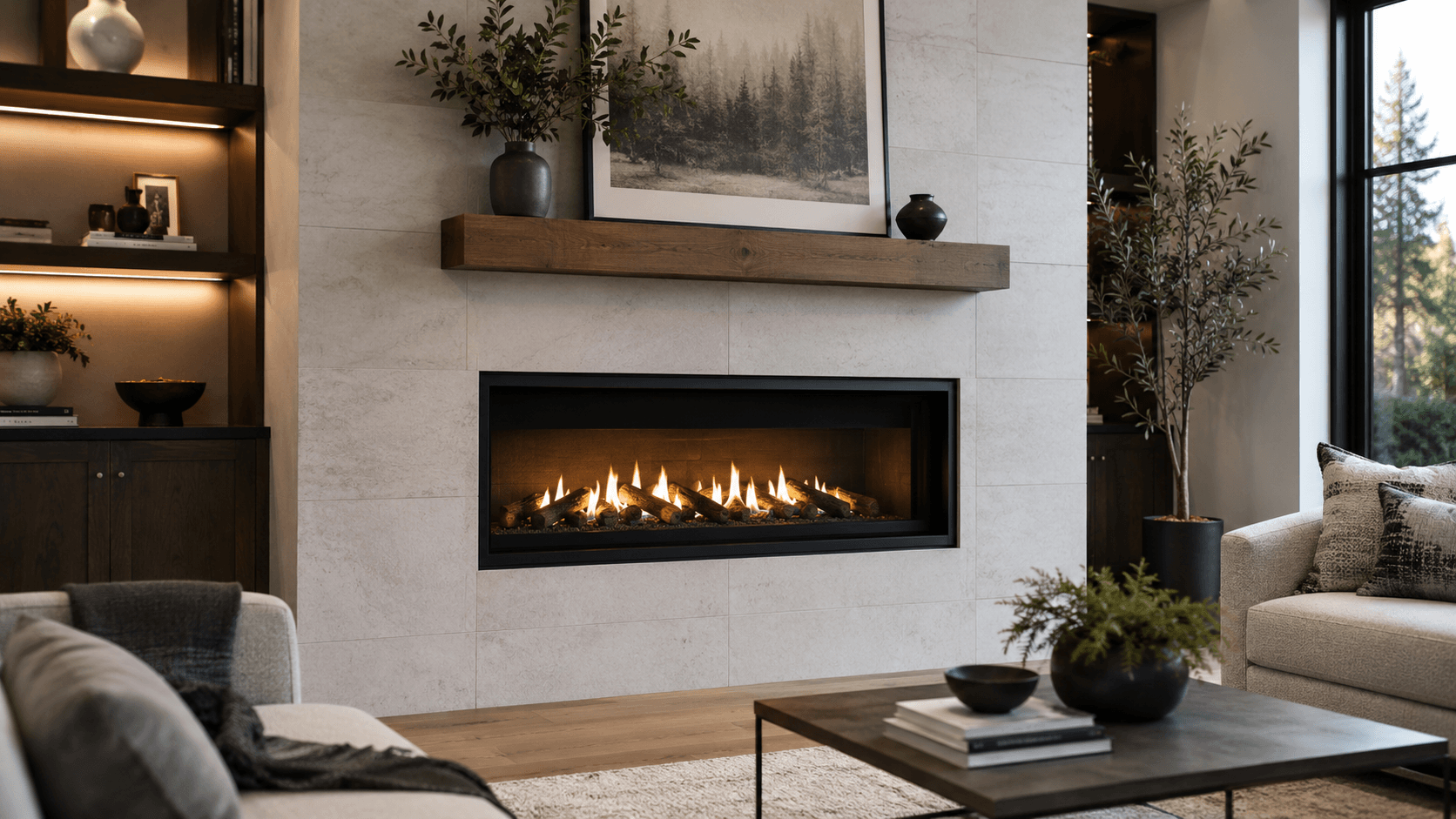
Direct vent is the most popular gas fireplace technology in the United States, and it's the right choice for most homeowners building or remodeling. It's also one of the most misunderstood. Direct vent means the appliance is sealed from your home — combustion air comes from outside, exhaust goes outside, and the only thing you see inside is the flame behind glass.
That sealed design is what makes direct vent flexible, efficient, and safe. It also means installation has real technical requirements: vent location, clearance to windows, framing depth, exterior chase design, power vent needs, and finishing plans all matter. This guide walks you through how the technology works, where it can go, what mistakes to avoid, and what to expect when you install one.
What Direct Vent Actually Means
A direct vent gas fireplace is a sealed combustion appliance. The firebox is closed off from your living space by a high-temperature glass panel. Two pipes — one inside the other in a coaxial configuration — run from the back or top of the firebox to a termination outside the home. Fresh outside air comes through one part of the vent system to feed combustion. Combustion exhaust leaves through the other part of the vent system.
Nothing from the fire should mix with the air in your house when the fireplace is installed correctly. No smoke, no exhaust, no open flame exposed to the living space, and no makeup air pulled from your room the way an open fireplace can do. The system is balanced — the appliance brings in combustion air from outside and sends exhaust outside.
That sealed design is why direct vent works in tightly insulated modern homes, why it doesn't depressurize your house the way an open fireplace does, and why it can be installed in many locations with the right exterior wall, roof, basement, chase, or power vent path.
Fireplace Insider note: A common misunderstanding is that “direct vent” means most of the heat goes out through the vent. That is not how modern direct vent fireplaces work. Some heat is exhausted, but many direct vent fireplaces still operate in the 70–90% efficiency range depending on the model. The important difference is that combustion gases are sent outside instead of being released into the room.
How Direct Vent Works Inside the Wall
The coaxial vent pipe is the key. From the outside it looks like a single pipe penetrating the wall or roof. Inside, it's two pipes — commonly 4-inch and 6-5/8-inch, or 5-inch and 8-inch on larger appliances. The exact vent size depends on the fireplace model and the manufacturer's installation manual.
The vent system can include 90-degree and 45-degree elbows for routing flexibility, with manufacturer-defined limits on total horizontal run, total vertical run, and number of elbows. Each elbow adds resistance that affects draft, so the venting tables published by every manufacturer specify maximum configurations.
Inside the firebox, the burner sits behind sealed glass that's rated for the operating temperature. Most modern direct vent fireplaces use an intermittent pilot ignition, millivolt system, or electronic ignition with battery backup options. Some systems can still provide flame and radiant heat during a power outage, although the blower may not run without power.
Direct Vent vs. B-Vent vs. Vent-Free
Three different gas fireplace technologies exist. They are not interchangeable.
| Type | Combustion Air | Exhaust | Efficiency |
|---|---|---|---|
| Direct vent | Outside | Outside (sealed) | 70–90% |
| B-vent (natural vent) | Indoor | Outside via vertical flue | 40–60% |
| Vent-free | Indoor | Released into the room | 99%+ (no venting losses) |
Direct vent is the modern standard for most new gas fireplace projects. It uses sealed combustion, vents exhaust outside, and works well in many rooms when the venting can be designed correctly. For most homeowners, this is the safest and most balanced choice.
B-vent pulls combustion air from inside the home and vents up a vertical flue. These units can look more like traditional fireplaces, but they are less efficient because some heated indoor air goes up the chimney. B-vent fireplaces are still produced, but they are much less common for new projects today.
Vent-free fireplaces keep almost all the heat in the room because there is no vent. That sounds attractive, and some customers first believe vent-free must be the better option. The tradeoff is that the heat, moisture, and combustion byproducts are also released into the living space. Vent-free fireplaces have their place where local code allows, but they are not the same as a sealed direct vent fireplace. We cover vent-free fireplaces separately.
Common buying mistake: Do not choose a fireplace only because it is the cheapest unit upfront. A direct vent fireplace is built into the wall and often finished with stone, tile, veneer, a mantel, or custom surround work. If a low-quality unit needs to be replaced in five or ten years, the homeowner may need to remove the finish material, reframe the opening, and redo the wall. It is usually better to choose a quality fireplace from the beginning.
Horizontal vs. Vertical Venting
Direct vent fireplaces can vent in different directions depending on the appliance and the layout of the home. The choice usually comes down to where the fireplace is located and whether the vent can reach an exterior wall, roof, basement path, or power vent route.
Horizontal venting (through an exterior wall)
The vent pipe runs from the fireplace to an outside wall cap. This is often the fastest and most cost-effective installation method when the fireplace is on or near an exterior wall. The exact slope, length, elbow count, and termination location must follow the fireplace manual.
Vertical venting (through the roof)
The vent pipe runs up through framing and out a roof termination cap. This is common when the fireplace is on an interior wall or when the customer wants the fireplace away from an exterior wall. Vertical venting can be a great solution, but it requires more planning because the pipe may need to pass through ceilings, floors, closets, attic space, or roof framing.
Power venting
Some projects require a power vent system when a standard horizontal or vertical vent path will not work. A power vent can give more routing flexibility, but it also adds cost, electrical requirements, and more technical planning. It should be selected only when the appliance allows it and when the venting design follows the manufacturer's requirements.
Combination runs
Many installations use a combination of vertical and horizontal sections to clear framing, windows, rooflines, rooms above, or mechanical systems. Every manufacturer publishes a venting table showing the maximum total length and maximum horizontal/vertical combinations. Stay inside the table or the appliance will not draft properly.
Real customer lesson: We recently had a customer who wanted a see-through fireplace in a wall, but the original venting path was impossible, even with a power vent. The solution was to pull the unit forward and route the pipe through a ceiling bay. In another project, venting through the ceiling was not possible because of the location, so the venting had to be routed through the basement using a power vent system. This is why the fireplace location and vent path must be planned together.
Vent Termination Clearances
The exterior vent cap can't be placed just anywhere. Building codes and manufacturer instructions specify minimum distances from windows, doors, soffits, decks, gas meters, grade, and other building features. These clearances exist because the cap releases warm exhaust, and you do not want that exhaust entering the home or creating problems around outdoor spaces.
Specific clearances vary by manufacturer and by jurisdiction, but representative minimums look like this:
| From | Typical Minimum Clearance |
|---|---|
| Grade, deck, or porch surface | 12 inches |
| Operable window or door | 12 inches (for appliances under 100,000 BTU) |
| Permanently closed window | 12 inches |
| Unventilated soffit | 12 inches |
| Under a deck or porch ceiling | 12 inches (with conditions) |
| Gas meter or regulator | 3 feet horizontal, or 15 feet vertical |
These numbers are typical, not universal. The installation manual for your specific appliance is the authority, and local building inspectors may enforce both the manual and any local amendments. If the exterior wall is vinyl siding, many manufacturers also require a vinyl protector kit to help protect the siding around the termination.
Where You Can Put One
Direct vent's flexibility is what makes it so popular. With a sealed combustion system and different venting options available, a direct vent gas fireplace can often go in:
- Living rooms, family rooms, and great rooms
- Bedrooms and primary suites, when the appliance and local code allow it
- Master bathrooms and spa-style spaces, when approved by the manual and local code
- Basements with a proper venting path to outside
- Second-floor rooms with the right venting path
- Interior walls with planned vertical venting or power venting
- See-through configurations between two rooms
- Corner installations
- Outdoor use as a separate appliance category — see our outdoor gas fireplaces
What you cannot do is install a direct vent appliance without a venting path to outside. There is no such thing as an unvented direct vent fireplace. If the room has no exterior wall, no roof path, no basement path, and no possible power vent route, you need a different appliance type — most likely an electric fireplace or a vent-free unit where local code allows.
Interior wall advice: When a customer wants a direct vent fireplace on an interior wall, the best next step is usually a site visit with the technicians who will install it. The venting may need to run through the ceiling, through a closet, through an exterior chase, through the basement, or through another hidden path. There are often ways to make it work, but the route needs to be evaluated before the fireplace is ordered.
Sizing: Matching BTU to Your Room
Same sizing logic as gas inserts. Rough rule of thumb: about 20 BTUs per square foot for moderate climates in well-insulated homes. Cold climates, drafty homes, and cathedral ceilings push that number up.
| Room Size | BTU Range (Moderate Climate) | BTU Range (Cold Climate or Drafty) |
|---|---|---|
| 200–400 sq ft | 10,000–18,000 | 14,000–22,000 |
| 400–700 sq ft | 18,000–26,000 | 22,000–32,000 |
| 700–1,000 sq ft | 26,000–34,000 | 32,000–40,000 |
| 1,000+ sq ft (open plan) | 34,000–42,000+ | 40,000+ |
Most direct vent gas fireplaces run between 20,000 and 40,000 BTUs on the high setting, with modulation or control features that let you turn the flame down for milder days. Do not oversize only for heat, but do not undersize the fireplace visually either.
One mistake we see is customers putting too small of a fireplace on a large wall. The fireplace may technically heat the space, but it can look undersized once the stone, tile, mantel, cabinets, or TV wall are finished. The right size is about heat, but it is also about proportion. A bigger wall usually needs a fireplace with enough glass, flame, and visual presence to look intentional.
Real Installed Cost in 2026
| Line Item | Typical Range |
|---|---|
| Direct vent gas fireplace (unit only) | $2,500 – $8,500 |
| Vent pipe and termination kit | $400 – $1,200 |
| Surround / facing material | $300 – $3,000+ |
| Gas line installation | $300 – $1,500 |
| Framing and finish work | $500 – $2,500 |
| Professional installation labor | $1,000 – $3,000 |
| Permit and inspection | $100 – $400 |
| Total installed (typical) | $5,100 – $20,000+ |
The $5,100 to $20,000+ range is realistic for many direct vent gas fireplace projects, but the final price depends heavily on the brand, size, fuel type, fireplace shape, venting complexity, power vent needs, framing, and finish materials. A standard traditional fireplace with a simple finish will cost much less than a large see-through or luxury fireplace with custom stone, tile, cabinetry, and complex venting.
At Fireplace Insider, we help customers think through the full project, not just the appliance price. The cheapest fireplace on the quote is not always the cheapest fireplace five or ten years later if it requires major wall work to replace or service.
Planning a direct vent install?
Send us your project details and we will help you choose the right fireplace, venting approach, and size for the space.
Request a Quote Call (203) 672-2567Brands Worth Shortlisting
The direct vent market is wide, but the right brand depends on the customer's budget, style, wall size, flame expectations, and long-term support needs. Here are the main direct vent gas fireplace brands we focus on at FireplaceInsider:
Best value: Montigo
Montigo is a strong value choice for customers who want a direct vent gas fireplace with good performance, clean design options, and dependable quality without immediately jumping into the highest luxury price range. It is a good brand to consider when the fireplace needs to look sharp, work well, and stay within a practical budget.
Best premium: White Mountain Hearth
White Mountain Hearth is a strong premium option for homeowners who want a reliable fireplace with traditional and transitional styling, good heat, and a wide range of configurations. It is a good fit for many family rooms, living rooms, basements, and remodel projects where the customer wants dependable performance and a finished look that feels substantial.
Best premium: Majestic
Majestic is another premium brand we trust, especially for homeowners who want a familiar hearth manufacturer with strong product documentation, dealer support, and a wide range of fireplace options. Majestic works well for traditional and modern projects where the customer wants a balance of price, reliability, flame presentation, and long-term service support.
Best luxury: Town & Country
Town & Country is the luxury choice when the fireplace is the centerpiece of the project. These fireplaces are selected for larger fireboxes, premium flame presentation, high-end design, and the kind of finished look that belongs in a custom home or major renovation. The price is higher, but for the right project, the visual result is in a different category.
Fireplace Insider recommendation: Do not choose the brand only by price. A direct vent fireplace gets built into the home. The better choice is the fireplace that fits the wall, delivers the right flame, supports the venting plan, matches the design style, and has the quality to stay in the wall for many years.
What the Installation Actually Involves
A typical direct vent install takes 1 to 3 days depending on complexity. Here's the typical sequence:
- Site evaluation — measure space, verify vent path, confirm clearances
- Confirm fuel type: natural gas or propane
- Confirm the desired look: modern, traditional, linear, see-through, or custom
- Decide whether the fireplace will be framed inside the room or pushed into an exterior chase/doghouse
- Review whether standard direct venting or a power vent system is needed
- Permit pulled with the local building department when required
- Framing the rough opening per the appliance's framing dimensions
- Setting the firebox in place
- Running the vent system from the appliance to the termination
- Gas line installation by a licensed gas plumber if a new line is needed
- Electrical connection for the blower, ignition, lights, or power vent when required
- Connection of glass front, log set, media, ember bed, or other interior options
- Surround and finish work — stone, tile, wood, drywall, veneer, mantel, or cabinetry
- Pressure test gas connections, leak check, light pilot, and verify operation
- Building inspection when required
- Final walkthrough with homeowner
This is not DIY territory. Direct vent installation requires gas, framing, venting, and code knowledge, plus jurisdiction-specific permitting and inspection. The appliance warranty in nearly all cases requires professional installation by a qualified installer.
When Fireplace Insider helps a customer choose a direct vent gas fireplace, we usually start with the fuel type, desired look, fireplace location, venting path, and whether the unit will be framed inside the room or placed into an exterior chase. Some customers do not want the fireplace to protrude far into the room, so a thinner unit may be the better fit. These details matter before the fireplace is ordered.
After the sale: Fireplace Insider stays in contact with customers after the fireplace is purchased. We help with product questions, warranty support, replacement parts, manuals, service reminders, and new feature updates when available. Customers can email or call us when they need help, even after the original order is complete.
Frequently Asked Questions
Can a direct vent gas fireplace go on an interior wall?
Yes, but the venting route has to be planned first. An interior wall may require vertical venting through the roof, a hidden chase, a closet route, a basement route, or a power vent system. A site visit with the installing technician is usually the best way to confirm what will work.
Does a direct vent fireplace need a chimney?
No. Direct vent uses its own dedicated vent system to an outside termination — through an exterior wall horizontally, through the roof vertically, or through another approved route depending on the appliance and venting design. No masonry chimney is required.
How efficient is a direct vent gas fireplace?
Many direct vent appliances operate in the 70–90% efficiency range depending on the model. Vent-free fireplaces may advertise higher efficiency because they do not vent outside, but direct vent fireplaces send combustion gases outside instead of releasing them into the room.
Can I put a direct vent fireplace in a bedroom?
Direct vent fireplaces are commonly used in bedrooms because of their sealed combustion design, but the final approval depends on the appliance manual and local code. Always confirm with the manufacturer requirements and local inspector before installation.
How long can the vent pipe run be?
It depends on the appliance and the venting kit. Many direct vent systems support long vent runs, but every manufacturer has specific limits for horizontal length, vertical length, number of elbows, and power vent options. The venting table in the installation manual is the authority.
Does a direct vent fireplace work in a power outage?
It depends on the ignition system. Some millivolt-controlled appliances can operate without 120V power. Some intermittent pilot systems have battery backup. The blower, lights, or power vent may not work without power, so confirm the exact features before ordering.
Can the vent terminate near a window?
Yes, if the required minimum clearance is met. Typical clearances may be around 12 inches from an operable window or door for many appliances under 100,000 BTU, but the exact requirement comes from the fireplace installation manual and local code.
What's the difference between direct vent and a gas insert?
A direct vent fireplace is a complete appliance designed to be framed into a wall. A gas insert is designed to slide into an existing masonry or factory-built wood fireplace, using the existing chimney as the vent path. Different starting points, similar goal: a cleaner, safer, more efficient gas fireplace experience.
Ready to shop?
Tell us the fuel type, fireplace location, wall size, and look you want. We will help you choose a direct vent gas fireplace that fits the project correctly.
Request a Quote Browse Direct Vent Gas Fireplaces